
The Voynich Manuscript has baffled the world’s greatest codebreakers, translators and historians for over 600 years, but its secrets may soon be revealed.
Created in the early 15th century, this 240-page text contains 38,000 words in a mysterious script known as ‘Voynichese’ alongside dozens of surreal illustrations.
Now, scientists claim that the real reason no one has ever managed to decipher the elusive text is that its pages have been bound out of order.
If researchers discover the right way of putting it back together, it could finally unlock the solution to this centuries-old puzzle.
Using modern statistical analysis techniques, researchers compared chunks of text on different pages to see if they were similar or disconnected.
They discovered that pages that appear to follow one after the other actually have very low levels of similarity.
Meanwhile, seemingly disconnected chunks of text share a striking statistical similarity, suggesting they were originally meant to be read together.
Co-author Dr Lisa Davis, of the Medieval Academy of America and Simmons University, told Live Science: ‘It doesn’t get us there [to a full translation], but it moves the ball because you can’t make sense out of a book where all the pages are mixed up.’

Experts say the reason the Voynich Manuscript (pictured) has not been translated is that its pages have been put in the wrong order
The Voynich Manuscript is widely regarded as one of the world’s most mysterious medieval manuscripts, due to its completely unique language and enigmatic illustrations.
The text is made from leaves of parchment carbon-dated to the early 15th century, while the earliest known records suggest that it might have been purchased by Holy Roman Emperor Rudolf II over 100 years later.
The book was later purchased by the Polish antiquarian bookseller Wilfrid Voynich, for whom it is named, and then entered the collection of Yale University’s rare book library in 1969.
Many academics have tried to figure out whether there is a hidden message beneath the bizarre imagery and strange text, and their conclusions have proven extremely controversial.
Academics have claimed the text contains censored information on sex, contraception and gynaecology, herbal remedies, secrets of pagan religions, and even magical spells.
However, Dr Davis and her co-author Dr Colin Layfield, from the University of Malta, now believe that everyone has been getting it wrong.
When doing research into the number of scribes that originally copied out the text, Dr Davis noticed that the writers’ handwriting alternated from page to page in a way that didn’t make sense.
Dr Davis says: ‘We don’t know if it’s a code, but there are some odd characteristics of the Voynich manuscript in terms of its physical structure.

Researchers found examples of illustrations that run between two pages that don’t actually face each other in the manuscript (pictured)

In the manuscript’s current layout (pictured), these illustrations aren’t facing their matching page, suggesting they have been put in the wrong order

Created in the early 15th century, this 240-page text contains 38,000 words in a mysterious script known as ‘Voynichese’ (pictured) that has remained impossible to translate
‘There are several examples where the image goes off the page in the middle and comes out on the other side, even though there are a bunch of pages in between.’
Typically, medieval books were made by folding pieces of parchment, usually made of animal skin, in half to make something called a ‘bifolium’.
Five of these ‘bifolia’ were then stacked together into a group known as a quire, and multiple quires were then stitched together along the spine to make a book.
But the researchers don’t believe that the Voynich Manuscript was ever meant to be put together this way.
Instead, the researchers think that the manuscript was meant to be a stack of individual folded bifolia, known as singulons, that were meant to be read one at a time like a stack of small pamphlets.
The manuscript’s current form likely comes from a later scribe or owner incorrectly binding a book they had no idea how to read.
Dr Davis says: ‘When you start to think about it in the context of the other strange features of the manuscript, all of those problems are resolved.
‘It solves the problem of each scribe writing one sheet. It solves the problem of the images crossing the gutter.’

Experts now say that they might be able to put the manuscript (pictured) back in the right order, potentially revealing any secrets that it may be hiding
In their paper, published in the journal Digital Medievalist, the researchers say they hope ‘linguists and cryptologists will revisit past work in the light of this hypothesis, ushering in a new era of Voynich Studies’.
However, there is still a lot more work to be done before scientists are able to put the Voynich Manuscript back in the right order.
To start with, Dr Davis wants to focus on some of the large water stains that appear in the middle of the manuscript.
These stains should be symmetrical from one page to the next, but don’t seem to match up at all.
If experts can find a way of comparing these stain shapes, it might finally help put some of the pages back together as they were originally meant to be read.
THE MYSTERIOUS HISTORY OF THE VOYNICH MANUSCRIPT
The first confirmed owner of the Voynich manuscript was George Baresch, an alchemist from Prague who had mentioned in a letter that he had found it in his library ‘taking up his space’.
He learned that Jesuit scholar Athanasius Kircher, in Rome, had published a Coptic dictionary and claimed to have deciphered the Egyptian hieroglyphs.
Baresch sent a sample copy of the script to Kircher, asking for clues to reveal what the mysterious manuscript meant.
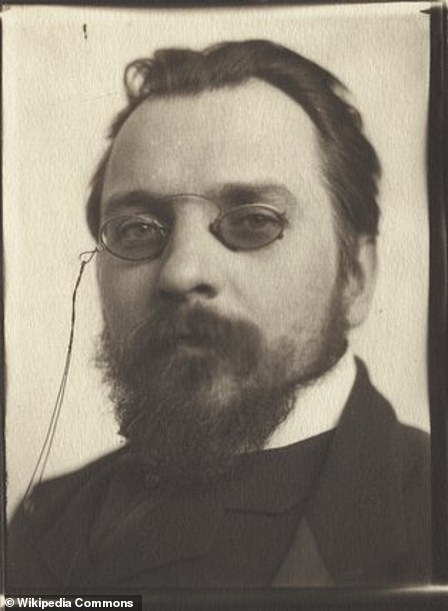
It was purchased in 1912 by a Polish-American antiquarian book dealer, named Wilfred Voynich (pictured) (1865–1930), from whom it gets its name
His 1639 letter to Kircher is the earliest confirmed mention of the manuscript that has been found to date.
Kircher asked for the book, but Baresch would not yield it as he prized owning it over knowing its true meaning.
Upon Baresch’s death, the manuscript passed to his friend Jan Marek Marci, who worked at Charles University in Prague.
A few years later, Kircher finally got his hands on the book when Marci sent it to him as he was a longtime friend and correspondent.
When Johannes Marcus sent it to Kircher, he included a letter written on August 19, 1665.
It claims that the book once belonged to Emperor Rudolph II (1552-1612), who paid 600 gold ducats (about 4.5 pounds of gold) for it.
The letter was written in Latin and has been translated into English.
The litany list of previous owners trying to unpick its secrets continues even further, as the manuscript embedded itself further into European folklore.
The manuscript is also thought to have once been in the possession of ‘Jacobj aTepen’, or Jakub Horcicky of Tepenec, a medical doctor who lived from 1575-1622 and was known far and wide for his herbal medicinal use.
No records of the book for the next 200 years have been found, but in all likelihood, it was stored with the rest of Kircher’s correspondence in the library of the Collegio Romeo.
It likely remained there until the troops of Victor Emmanuel II of Italy captured the city in 1870 and annexed the Papal States.
It was purchased in 1912 by a Polish-American antiquarian book dealer, named Wilfred Voynich (1865–1930), from where it gets its name.
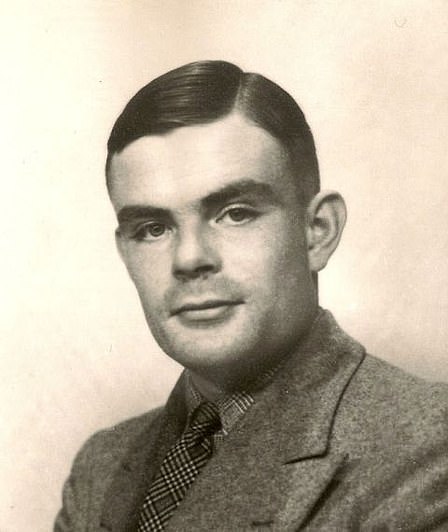
Alan Turing (pictured), the brilliant mind who spearheaded the campaign to crack the Enigma code at Bletchley Park during the Second World War, supposedly attempted to understand it, but found it impenetrable
His acquisition of the manuscript is different to its previous owners, from whom it was passed from hand to hand.
According to folklore, he happened upon a trunk that contained the rare manuscript now known as the Voynich manuscript while on an acquisitions trip.
He had it in his possession until he died, and put it on display to the public for the first time ever in 1915.
It further etched itself into folklore and the mystery surrounding it deepened from this point onward as its uncrackable code attracted the greatest minds for decades – all trying to uncover its meaning.
Wilfred subsequently relocated from Europe to New York and, following his death, the manuscript’s custodian became his wife Ethel Voynich (1864–1960).
Following her death, the manuscript found its way into the hands of another dealer named Hans P. Kraus (1907–88), who eventually donated it to the Yale library in 1969.
Alan Turing, the brilliant mind who spearheaded the campaign to crack the Enigma code at Bletchley Park during the Second World War, supposedly attempted to understand it, but found it impenetrable.
However, there has never been any concrete evidence to show that Turing attempted to study the manuscript.
Theodore C Peterson, a priest, embarked on the project of making a hand copy of the Voynich manuscript.
He completed it in 1944 and each page of the replica points out unusual features, which may be of interest in trying to decipher it, such as odd character sequences and frequently used words.
He worked on the Voynich until his death and it helped a Danish botanist and zoologist, Theodore Holm of the Catholic University, tentatively identify 16 plant species in the Voynich.
William Friedman (1891-1969) is remembered as one of the world’s foremost cryptologists and became involved with the Voynich in the early 1920s when he corresponded with its namesake.
During his work, he developed the theory that the Voynich manuscript represented a text in a synthetic language (using or describing inflexion).
John Tiltman was a British intelligence specialist, working in association with William Friedman.
Friedman asked Tiltman for his opinion on the Voynich MS text, and sent him copies of the final quire.
He concluded that the text is far too complicated to be the result of a simple cipher and to be the result of applying a standard cypher to some plain text.
He spent some time discussing the option of a synthetic or ‘universal’ language as proposed by Friedman.
The FBI also tried during the Cold War, apparently thinking it may have been Communist propaganda.
The US National Security Agency collaborated with German code-breaker Erich Hüttenhain based on the earlier work of British code-breaker John Tiltman because they had a notion that it might contain communist propaganda.
Ultimately, a consensus emerged: that the manuscript was either impossible to solve or else written in gibberish, as an elaborate practical joke.
Dr Gerard Cheshire, a researcher at the University of Bristol, claimed that it was written in a dead language – proto-Romance – and then by studying symbols and their descriptions he deciphered the meaning of the letters and words.
However, Dr Cheshire’s supposed translation was widely criticised by experts in the field, with Voynich Manuscript expert Dr Lisa Davis, of Harvard University, branding it ‘gibberish’.
The University of Bristol subsequently published a statement distancing itself from Dr Cheshire’s study, saying that it was ‘entirely the author’s own work and is not affiliated with the University of Bristol, the Faculty of Arts or the Centre for Medieval Studies.’